By Chioma Vivian James
In a landmark gathering that could redefine the trajectory of gender inclusion in Nigeria, the First Lady, Oluremi Tinubu, has rallied women across the nation to step decisively into positions of influence, declaring them a formidable force capable of reshaping the country’s economic and political future.
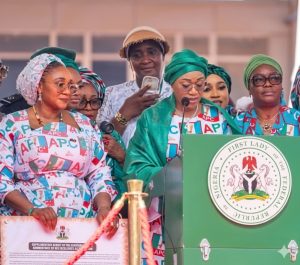
Addressing the crowd at the National Women Mega Empowerment and Rally held at the Moshood Abiola Stadium, she underscored the strategic importance of women, who constitute over half of Nigeria’s population, in driving meaningful national development.
“The significance of this gathering cannot be overstated,” Tinubu said. “We are not just participants in nation-building we are central to it.”
Her remarks set the tone for what many observers described as a defining moment in the evolution of women’s advocacy in Nigeria one that moves beyond rhetoric toward coordinated action and measurable impact.
At the heart of the event was a bold push for economic empowerment. The First Lady applauded the Minister of Women Affairs and Social Development, Imaan Sulaiman-Ibrahim, for executing targeted initiatives designed to place financial resources directly in the hands of Women an approach widely seen as a catalyst for grassroots economic growth.
According to Tinubu, empowering women to make informed economic decisions creates a ripple effect that strengthens households, stabilizes communities, and accelerates national prosperity.
She aligned these efforts with the Renewed Hope Agenda of President Bola Ahmed Tinubu, emphasizing that the administration is committed to ensuring women are not only visible in governance spaces but also influential in shaping policies and outcomes.
A major highlight of the rally was the formal presentation of the Women’s Charter for National Development—a comprehensive framework articulating the aspirations and expectations of Nigerian women. The charter calls for expanded political representation, improved access to finance, enhanced economic opportunities, stronger family systems, and inclusive governance structures.
Receiving the document, the First Lady pledged to personally deliver it to the President, describing it as both a “social contract” and a “policy compass” for the nation’s future.
“This is our charter,” she affirmed. “And we will see it to fruition.”
In her address, Minister Imaan Sulaiman-Ibrahim characterized the rally as the emergence of a “coordinated and unstoppable force,” driven by the ambitious “Power of 10 Million Women” initiative.
The movement aims to mobilize and align women across Nigeria’s 774 local government areas into a unified bloc capable of influencing governance, shaping public discourse, and driving economic inclusion on an unprecedented scale.
“This is not just a gathering,” she declared. “It is a deliberate convergence of strength into action, of voices into authority, and of presence into impact.”
Speakers at the event stressed that Nigerian women have long demonstrated capacity across sectors from agriculture and trade to entrepreneurship and public service but have often lacked the structural coordination needed to translate effort into influence.
The new movement seeks to bridge that gap, transforming dispersed contributions into a cohesive force with clear direction and purpose.
Beyond policy and politics, the rally also reinforced the critical role of women in shaping the nation’s moral and social fabric. Tinubu called on mothers and caregivers to remain steadfast in raising responsible, value-driven citizens who will carry forward the vision of a stronger Nigeria.
As part of the empowerment initiative, the First Lady performed the symbolic distribution of livelihood support items, including tricycles, power tillers, sewing machines, grinding machines, hair dryers, and freezers aimed at boosting women’s economic independence and productivity.
Analysts say the rally signals a shift from fragmented advocacy to structured mobilization, with the potential to significantly alter Nigeria’s development landscape.
With momentum building around the “10 Million Women” movement and growing political will at the highest levels of government, the message from Abuja was clear: Nigerian women are no longer waiting in the wings, they are stepping forward, organized, and ready to lead.