By Uloma Peace Okorie
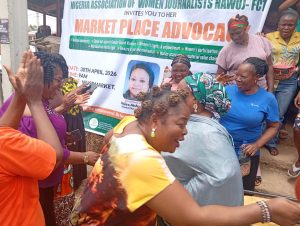
The Nigeria Association of Women Journalists (NAWOJ) has intensified its grassroots advocacy efforts with an outreach to market women in Wuse Market, Abuja, focusing on health awareness, economic empowerment, and political participation ahead of the 2027 general elections.
Speaking during the programme, the National Chairperson of NAWOJ, Hajia Aisha Ibrahim Bura, commended the FCT chapter for bringing advocacy directly to the marketplace, describing the initiative as a strategic move to engage women at the grassroots level.
She urged women to take their health seriously while positioning themselves for leadership and active participation in governance, stressing the need to increase women’s representation in elective positions.
Bura decried the continued marginalisation of women, calling for a shift from passive involvement to active engagement in decision-making processes.
She said there should be no tolerance for gender-based violence, ignorance of reproductive health rights, or exclusion of women from economic opportunities, particularly as the country approaches another election cycle.
In her welcome address, Chairperson of NAWOJ FCT, Comrade Bassey Ita Ikpang, said the outreach was designed to provide women with critical information and empower them with knowledge that can improve their lives.
She explained that beyond reporting, women journalists have a responsibility to advocate for societal change, which informed the focus on vaccine awareness, reproductive health, women’s rights, and political inclusion.
Ikpang also encouraged women to speak out against abuse and seek help when necessary, emphasizing that their wellbeing must remain a priority.
Health experts at the event addressed key issues affecting women and children. Executive Director of Vaccine Network, Dr. Chika Offor, dispelled myths surrounding vaccines, particularly the Human Papillomavirus (HPV) vaccine, urging women to ensure their children are fully immunised.
Also, Dr. Ejike Oji highlighted the importance of reproductive health and introduced the 5 Million Women Database initiative, which he said is aimed at providing women with access to health information, telemedicine, skills development, and economic opportunities.
He noted that the initiative is designed to support women, especially those in the informal sector, by improving their access to essential services and enhancing their economic visibility.
In a keynote address presented on behalf of the Raw Materials Research and Development Council (RMRDC), the council emphasized the importance of integrating women into Nigeria’s raw material value chains as a pathway to economic empowerment and national development.
The council noted that despite Nigeria’s abundant natural resources, many women remain at the lowest levels of production, limiting their economic potential. It called for deliberate policies to expand women’s participation across the value chain.
Some of the participating market women commended NAWOJ and its partners for the initiative, noting that it had improved their understanding of health issues and civic responsibilities.
They pledged to participate actively in the electoral process and called for free, fair, and inclusive elections.
The NAWOJ National Chairperson also reaffirmed the association’s commitment to supporting grassroots development, including plans to improve infrastructure within markets to enhance mobility for women.